Celebrating Byron Caughey, 1957-2026
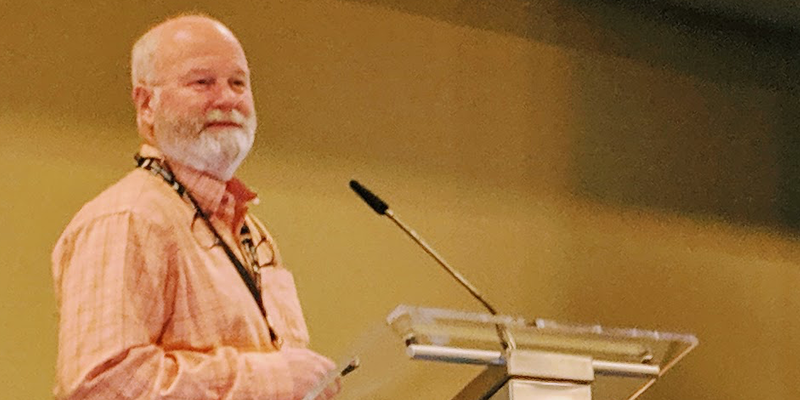
Byron Caughey lecturing at Prion2019 in Edmonton, Alberta.
Byron Caughey, a wonderful friend and mentor and a giant of the prion research field, passed away on Sunday.
For nearly 40 years at Rocky Mountain Laboratories in Hamilton, Montana, Byron advanced our understanding of what prions are, what prion disease is, how to detect and diagnose it, and how we could eventually treat it. In the 1980s and 1990s he worked out many basics of the biochemistry and cell biology of PrP and prions [Caughey 1989, Caughey 1990, Caughey 1991]. By the mid-1990s he had provided a powerful demonstration that PrP could misfold in a cell-free system, and maintain certain prion strain properties in the process [Kocisko 1994, Bessen 1995], leading him to analogize prions to “ice nine”, the apocalyptic conformer of water from Kurt Vonnegut’s Cat’s Cradle. If all of these basic science contributions had been the extent of Byron’s career, it would already have been a smashing success. But Byron worked on iteratively improving methods for replicating prions in vitro, leading to the use of recombinant PrP as a substrate for PMCA [Atarashi 2007], then to QuIC [Atarashi 2008], and ultimately to the invention of RT-QuIC [Wilham 2010, Atarashi 2011]. Implemented in routine clinical practice in 2014 and widely standardized on a protocol Byron’s lab developed [Orru 2015], RT-QuIC has absolutely transformed the diagnosis of prion disease, allowing a virtually definitive diagnosis while the patient is still alive. While receiving a positive RT-QuIC test is not good news, the certainty in the diagnosis relieves a major burden on families in end-of-life decision-making, and the ability to definitively include patients with prion disease in clinical trials is a boon to our ability to develop drugs for this disease. Byron went on to apply RT-QuIC to different diagnostic specimens and different diseases, but never lost his interest in making fundamental breakthroughs in our understanding of prions. He was convinced that the misfolded protein must have a particular type of structure called a PIRIBS [Groveman 2014] and spent years and years on a long bet that this could be proven by purifying and characterizing a sufficiently uniform preparation of prions from brain tissue. In 2021, he and Allison Kraus finally achieved a breakthrough, publishing the first cryo-EM structure of a prion [Kraus 2021], an advance which has since been replicated and extended by many others in the field [Hoyt 2022, Manka 2022, Alam 2024], finally confirming at atomic resolution what was long suspected: that different prion strains are encoded in different shapes of misfolded PrP.
What you would never know from searching Google Scholar, but you probably know if you have worked in the prion field in the past decade, is that Byron’s lab trained everyone on RT-QuIC. There were many holdouts initially: those who found the purification of recombinant PrP difficult, or believed that only bioassay was authentic, or that scrapie cell assay was good enough. But RT-QuIC gradually became universally adopted, for two reasons. First, it just was the better assay. Second, anytime someone had trouble implementing it, Byron welcomed them with open arms to come into his lab to learn. In 2014, Sonia and I showed up in Hamilton, two young people with hope and a dream, who were not yet even PhD students, me having held a pipette only once in my life. With painstaking patience, Christina Orru and Brad Groveman and Matteo Manca trained me to run RT-QuIC, and Andy Hughson trained me to make recombinant PrP, so that we could take all this knowledge back to the Broad Institute. Dozens of researchers rotated into Rocky Mountain Labs for similar stints of a few weeks or a few months to observe and train, beginning before the first RT-QuIC paper was even published and continuing to this day. Even though objectively I’m sure we placed a significant burden on them, the lab was like a tight-knit family that welcomed each of us as its honored guests. Christina Orru joked that they should set up an operating theater for all the visitors wanting to watch them pipette into a 96-well plate in the hood. There was no expectation that this was a 2-way collaboration where we had something to offer his lab. Byron just wanted to share good science with the world.
In 2015, Sonia and I came back to Hamilton, this time with an offer from Ionis Pharmaceuticals to send antisense oligonucleotides (ASOs) targeting the mouse PrP gene so that we could test whether they increased survival in prion-infected mice. Byron immediately offered that his lab would launch mouse studies. We’d look for funding in due time, he said (eventually, CJD Foundation helped support some of the work), but the important thing was to get the research underway.
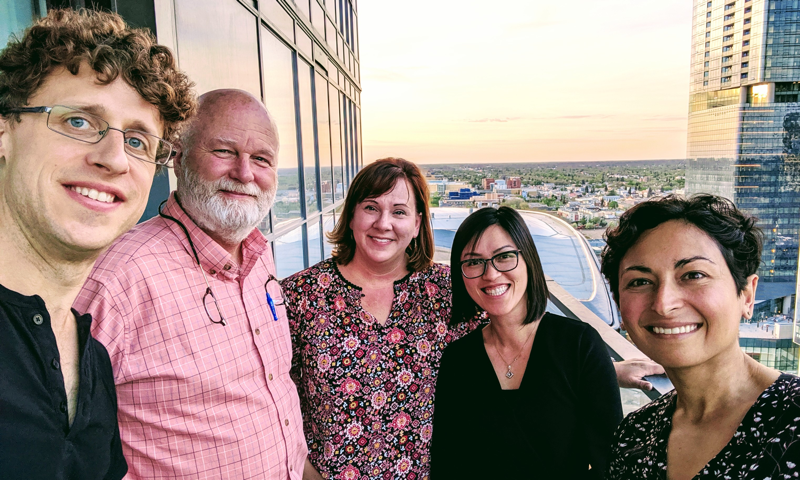
Me, Byron, Anne Smith (head of prion clinical program at Ionis), Hien Zhao (head of prion preclinical research at Ionis), and Sonia, at Prion2019 in Edmonton, Alberta.
The project immediately encountered an obstacle. The stereotactic dosing procedure required to administer the ASOs to mice was rather technically difficult. It was, in an ideal world, the kind of thing you really wanted to learn side-by-side with someone who had done it ten thousand times. But federal rules made it near impossible to get permission for anyone from Ionis, a private company, to come train people in Byron’s NIH lab on this procedure, or to allow anyone from Byron’s lab to go train at Ionis. I could have pulled my hair out with frustration, but Byron, used to this sort of thing, was undaunted. There ensued several rounds of pilot experiments in which Greg Raymond and Brent Race at Rocky Mountain Labs worked tirelessly to figure the method out on their own, emailing troubleshooting notes back and forth with scientists at Ionis. Byron spent his whole career at NIH, and was often at odds with this type of red tape. For all that I saw the friction that bureaucracy caused in Byron’s life, he also became a role model for me for the grace and patience with which he navigated it. No matter what human systems obstacles popped up, Byron never let them get in the way of good science.
The ASOs worked. In his usual way, Byron was in it to do right by the science and to do right by his people. Byron was never in it for Byron. Greg had delayed his retirement to see the studies through, and Byron felt strongly that Greg should get his credit, but as to whether Byron himself got any recognition, he had no dog in the fight [Raymond 2019]. We went on to dose hundreds of animals with ASOs at the Broad Institute [Minikel 2020]. The stereotypical attitude of academia would have been to feel that we were eating Byron’s lunch. But Byron was purely happy for us, writing in 2020:
It’s great to see your BioRXiv article on your further ASO work! Still looking good. The effects that you got with more continuous prophylactic treatments are amazing!
Byron was always like this. In a field that was often competitive and adversarial, he never missed a chance to make a self-effacing joke. When he took the stage at Prion2015, giving the keynote that Stan Prusiner was originally slated to give, he quipped that he had tried to grow more hair in order to be an effective substitute, but that it had grown on his face instead of his head. This is a field where it’s common to boast of one’s N peer-reviewed publications and important contributions. But while the summary of Byron’s contributions I gave at the top of this post is necessarily (very) incomplete, I am certain that Byron’s main objection would be to deny that he had any role whatsoever in the invention of RT-QuIC — he often issued rebuttals along the lines of: “Ryu Atarashi did everything! I just provided a lab space!”
I was at best an outsider to Byron’s lab, but got to see a few of his endearing quirks. His house in the mountains outside Hamilton was surrounded by a frisbee golf course of his own design, where lab members could come play. He had a knack for memorable turns of phrase. When describing the disease stage at which we had treated mice with ASOs, he told CJD Foundation that the animals had “a rip-snorting prion infection”. When explaining the cryo-EM structure of prions to a reporter, he declared that “we finally got a glimpse of its ugly mugshot.”
With someone so generous, it is easy to wonder: did we do right by Byron? In the 12 years that Sonia and I interacted with Byron, we only ever took. But writing this post has helped me to reflect: Byron didn’t want anything in return. The only way we do right by Byron is to cure this disease. We can never pay it back. Let’s pay it forward.

About Eric Vallabh Minikel
Eric Vallabh Minikel is on a lifelong quest to prevent prion disease. He is a scientist based at the Broad Institute of MIT and Harvard.