Jeff Carroll: searching for the toxic species in Huntington's disease
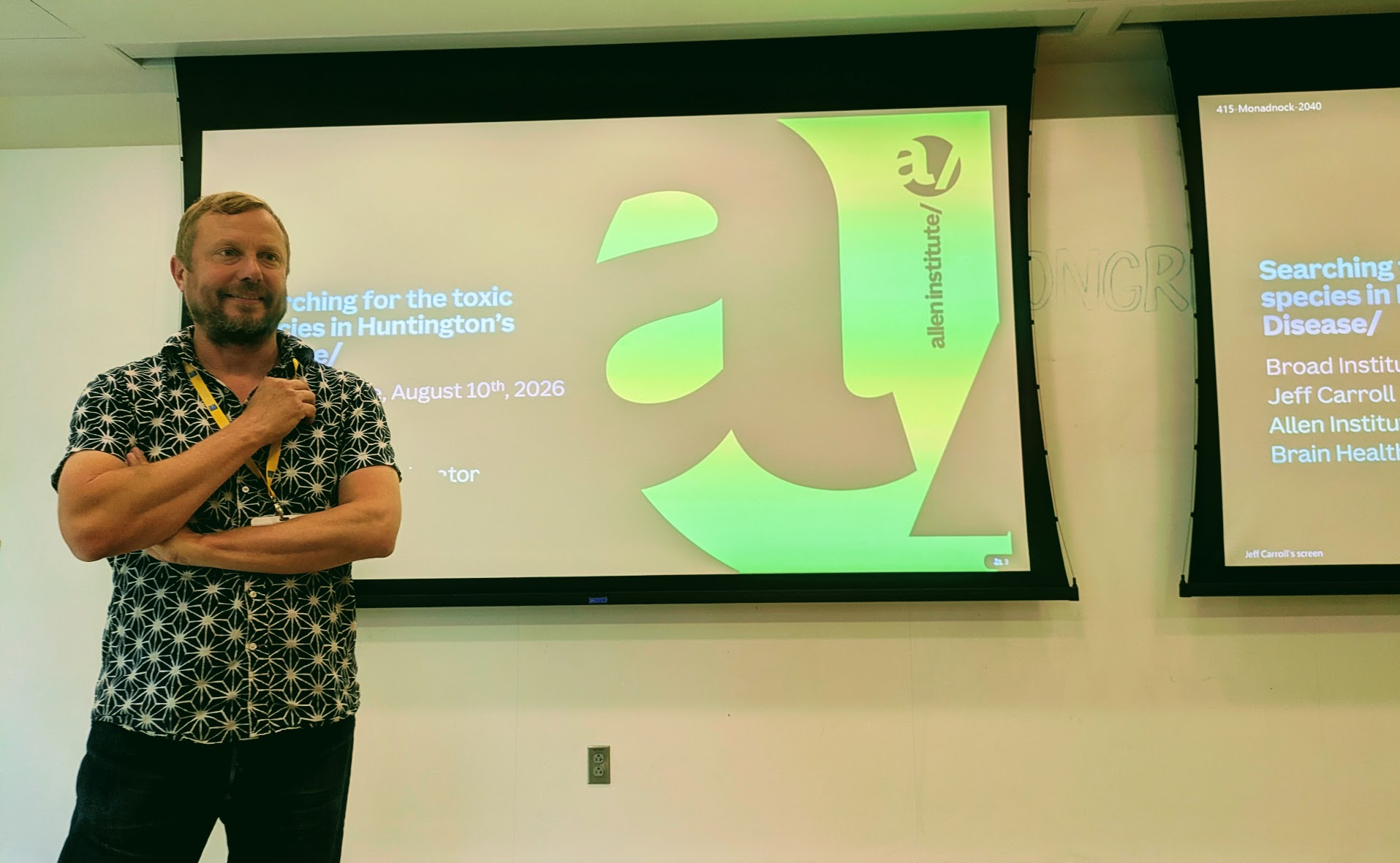
Dr. Jeffrey B. Carroll (Allen Institute Brain Health Accelerator) visited our lab today to give a guest lecture: “Searching for the toxic species in Huntington’s disease.”
“Ground zero” for everyone working on HD was the discovery of the CAG repeat expansion in a gene then dubbed “IT15”, for interesting transcript 15, now known as huntingtin (HTT) [Huntington’s Disease Collaborative Research Group 1993]. GWAS on the residuals for age of onset, after controlling for CAG repeat length, yielded practically a unified KEGG pathway of hits surrounding mismatch repair [Gem-HD 2015]. It had been known for years that in the most affected brain tissues, the length of the CAG repeat in a HD patient is not a single value but a smear [Telenius 1994]. Single-cell data show that the somatic expansion of the CAG repeat is most severe in spiny projection neurons (SPNs), the most affected cell type, and that it becomes toxic only at a threshold of 150 CAGs in an individual cell [Handsaker 2025]. But that doesn’t tell us what the toxic species is. In the presence of a very expanded CAG repeat, HTT fails to splice properly, resulting in an mRNA dubbed HTT1a reading into intron 1 [Sathavisam 2013]. At first people doubted this finding because it was found in mice with 150 CAG repeats, whereas human patients often have germline repeat lengths of just 40-50 CAGs. But now that we know that individual cells that are sick have 150 CAGs, it appears more plausible that HTT1a could actually be the toxic species. HTT1a is seen in a variety of mouse models including BAC-HD which have the full human gene.
Some of Jeff’s early work was on allele-specific silencing [Carroll 2011]. Later he collaborated with Wave Life Sciences to compare ASOs that knock down mutant HTT, including HTT1a (mutASO) versus those that knock down mutant and wild-type HTT but not HTT1a (panASO), using Q111 HD knock-in mice [Bragg 2026]. MutASO completely abolished the intracellular huntingtin aggregates, while panASO made very little difference. By RNAseq, PanASO knocked down HTT but had no other effect on the transcriptome, while MutASO had a huge transcriptomic impact, largely restoring a normal transcriptonal program. In human (unlike knock-in mice) it is impossible to allele-selectively target HTT1a with an ASO, though, because it contains no nucleotides not present in HTT pre-mRNA. An siRNA that is only active in the cytosol, however, could do this. Anastasia Khvorova’s lab therefore developed an siRNA that specifically knocks down HTT1a while having no effect at all on full-length HTT, and characterized it in Q175 mice with Gill Bates’ lab [Papadopoulou 2026]. They found that there was benefit on transcriptomic profile and histologic readouts exclusively when HTT1a was lowered.
All this being said, to date there are not many human data supporting the presence of HTT1a in human brain tissue. Since HTT1a is polyadenyalated and exported to cytosol, in principle, this could be examined through polyA enrichment and 3’ sequencing, or through doing RNAscope and looking at localization of probes to the intronic portion. These data do not exist yet.
Jeff noticed that ASO treatment to knock down HTT also reduced HTT somatic instability. He briefly wondered whether huntingtin may actually control mismatch repair in trans somehow. But then Ionis published that ASOs sometimes not only cleave transcripts, but also affect transcription in cis [Lai 2020]. If the gene is not being transcribed, the repeat will not expand. Jeff pivoted to studying zinc fingers that bind HTT which had previously been developed by Sangamo and licensed to Takeda [Zeitler 2019]. Jeff found that as expected, HTT1a was lowered by ZF-KRAB but not ZF without an effector domain. Yet when you look at somatic instability, even ZF minus any effector reduced it, albeit not as much as ZF-KRAB [Mathews 2025]. Apparently just by sitting on the DNA, the zinc finger prevents the CAG repeat from expanding.
Uniqure (AMT-130) and Alnylam (ALN-HTT) both target HTT1a but all other things in the clinic right now do not. Neither of those would be expected to reduce somatic instability though. Only a zinc finger or epi-editor that acts at the transcriptonal level will also reduce somatic instability. A lot of zinc finger IP was held by now-bankrupt Sangamo and is being auctioned off today; there are also several academic efforts to design DNA-binding proteins [Ichikawa 2023, Glasscock 2025].
Q&A
Q. Do you have hope for the splice modulating small molecules in the clinic?
A. Yes, they don’t lower HTT1a but I’d love to be wrong about the importance of HTT1a. It could yet turn out that HTT1a is just a phenomenon that shows up in ultra long CAG repeat cells but isn’t a major driver of pathogenesis. Based on what we know now it’s worth testing these therapies.
Q. What are the GWAS hits that don’t clearly map to mismatch repair?
A. TCERG1 is involved in transcriptional elongation. MED15, which has a polyQ domain itself, also affects transcription somehow. And a gene involved in cholesterol metabolism. There are also cis variants in HTT — the CAA interruption of the CAG repeat is present in most people, but those who are missing it have 10 years earlier onset.
Q. Is MSH3 a potential target for other CAG repeat disorders?
A. There aren’t enough patients with SCA or any other one CAG repeat disorder to do a GWAS, so we don’t have human genetic evidence, but it is plausible. We will probably only learn the answer by testing MSH3 lowering clinically. MSH3 is an excellent drug target because its knockout appears pretty phenotypically silent and does not seem to increase cancer risk.
Q. What is the biggest impact of CHDI funding in HD?
A. It’s all the boring stuff that’s essential for drug development but very hard to fund by any other mechanism. ENROLL-HD, which is a 21,000 person natural history study; biomarker development; tool and assay and reagent development.

About Eric Vallabh Minikel
Eric Vallabh Minikel is on a lifelong quest to prevent prion disease. He is a scientist based at the Broad Institute of MIT and Harvard.