Divalent siRNA clinical trial is now recruiting
We announced today that a first-in-human clinical trial of PrP-siRNA is now enrolling symptomatic participants with prion disease. Patients, families and caregivers can learn more on the study’s ClinicalTrials.gov posting as well as official announcements on the Prion Alliance blog and our Community Statement. People interested in participating in the trial should contact a study site to ask to be screened for eligibility.
This blog post will review how we got here, what this trial is designed to accomplish, and what may come next.
How we got here
PrP is the protein that causes prion disease, and we and others hypothesize that reducing the amount of PrP in the brain could be an effective therapeutic strategy for prion disease. We’ve worked for over a decade on therapeutic approaches to lower PrP, including antisense oligonucleotides, which led to a Phase 1 clinical trial that Ionis Pharmaceuticals enrolled in 2024 and recently re-opened. However, one approach isn’t enough. We are always looking for additional ways that we can safely and potently lower PrP in the human brain. Hence the CHARM study we published last year, and this trial of a divalent small interfering RNA (siRNA) molecule.
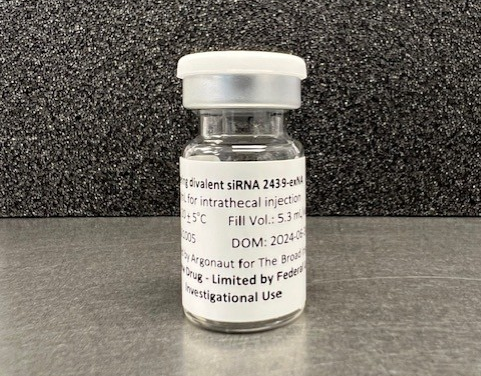
Our lab at the Broad Institute has been working since 2020 on a divalent siRNA, in collaboration with Anastasia Khvorova’s lab at UMass Medical School. Last year we released a preprint describing the investigational drug that we developed, called either 2439-s4, 2439-exNA, or PrP-siRNA [Gentile 2024]. In humanized mice, a single dose lowers PrP in the brain for months. A similar drug with a sequence designed to target the mouse PrP gene was effective at increasing survival time in a mouse model of prion disease. Earlier this year we announced that our Investigational New Drug (IND) application had been cleared by the U.S. Food and Drug Administration, meaning that we have permission from the regulatory authority to initiate a clinical trial in humans. The drug vials are manufactured and waiting to be used:
What getting to the clinic means
We do not yet know if PrP-siRNA is safe or effective — that’s why we need to do clinical trials. Clinical trials are still research. While our life’s mission is to develop a safe and effective therapy for prion disease, we are not there yet. This clinical trial is not the finish line, but more of a starting line — after years of work in animal models, we are finally ready to test the drug in humans and begin to gather clinical data.
Most drugs that enter clinical trials eventually fail due to poor safety, a lack of efficacy, or other problems. Even when a drug succeeds and eventually gets approved, the very first drug is usually not a cure for the disease — often it takes multiple iterative improvements in drug technology over years to turn a fatal disease into an effectively manageable condition. For all these reasons, we need more than one shot on goal to develop an effective drug for prion disease. It is possible that while this trial is open, clinical trials of other drugs for prion disease may launch as well. Our goal is not to compete — our goal is to offer more options to patients and increase the probability that some drug, ideally more than one drug, is ultimately successful. If multiple trials are enrolling at the same time, you should discuss with your doctor which one, if any, is right for you. We are not asserting that our trial or our drug are better than anyone else’s.
Overview of this trial’s design
This is a small study in which 15 symptomatic participants will each receive a single dose of the investigational drug.
FDA advised us that a single dose toxicology study in animals would allow us to do a single dose clinical trial in humans. We conducted single-dose toxicology studies in animals, both because this was what our funding at the time could support, and because they are quicker than chronic toxicology studies. In other words, the reason we are able to do a clinical trial at all right now is because we made the decision to move forward with a single dose. One dose won’t last forever, and ultimately, PrP-siRNA will need to be dosed repeatedly to continue helping patients. Nonetheless, we believe it is reasonable to study a single dose in this study, because our mouse data show that a single dose can have effects lasting for months, potentially long enough to make a difference in this very rapid disease. Moreover, durability of drug effects are often different in mice than in humans, and having human data from a single dose will help us to decide how frequently we should dose in future trials. FDA is requiring additional safety studies in animals before we can give repeated doses to patients, and we are working on conducting those studies, but they are not complete yet.
The trial will be a “single ascending dose” trial, which means that each patient will receive a single dose, and that the dose level tested will increase over the course of the trial — from 50 to 100 to 200 milligrams. These doses are extrapolated from doses given to animals and were cleared by FDA based on our animal safety data. But we do not yet have any human data to know which doses might be safe enough and potent enough, so we have to try a range of doses, escalating gradually to make sure we don’t expose anyone to unnecessary risk.
To assess whether PrP-siRNA is lowering PrP as it was designed to do, and whether it is safe, it is useful to be able to compare to a similar group of patients not on the drug. In many clinical trials, this is done by randomizing patients to drug or to placebo. In this trial, we chose not to have a placebo group. In our experience, clinical trials don’t enroll continuously. There are often pauses built in to evaluate safety before the dose level can be increased, for example, or for other regulatory, ethical, or safety reasons. Often after a trial completes, there is a gap before a next trial is launched, and no trial for new patients to enroll in the interim. We made the decision that whenever enrollment our trial is paused, we will ask would-be participants if they would be willing to participate in a parallel observational arm, where patients who meet the same eligibility criteria are monitored and undergo some of the same study procedures but do not receive the investigational drug. Our hope is that this will give us a good comparator for the data from drug-treated patients, without needing to treat anyone with placebo. This is an experiment, and we cannot guarantee that the results will be clear or definitive — but we felt this is an area where it is worth attempting to innovate.
What participants can expect in this trial
Participants who are considering volunteering for this trial will first undergo a screening visit to determine if they are eligible and are willing to consent to participate. In the consent process, participants will be informed about some known risks of participating in this trial — but remember that not everything can be anticipated, and there are likely to be unknown risks as well. Those who meet criteria and choose to enroll will then complete a series of study visits. For those in the observational arm — that is, those not receiving drug — this will be a baseline visit plus follow-up visits 4 and 8 weeks later. For those in the drug treatment arm of the study, there will be a baseline visit in which the investigational drug is administered and they are admitted to the hospital overnight for monitoring. Afterwards they will return for several in-person visits, at 1, 2, 4, 8, 12, and 24 weeks post-dose. This sequence of visits was designed to allow us to monitor whether the drug is safe and whether it is doing its job of lowering PrP. Each visit will involve a variety of activities, such lumbar puncture for CSF, blood draws, MRI scans of your brain, neurological and medical exams, cognitive testing, reviewing any adverse events and changes in medications, and more. Not all activities will occur at every visit.
It is important to have realistic expectations going into this trial. There are currently no human data to suggest that PrP-siRNA will be beneficial. In mice, our data suggest that lowering PrP can slow further disease progression but will not halt the disease and will not reverse symptoms that have already begun. No one should enter this trial hoping that the drug will restore them to the state they were in before they developed disease.
Possible outcomes from this trial
This is a first-in-human trial; we cannot predict what it may tell us and many outcomes are possible. The trial was designed to help tell us whether PrP-siRNA has a future — whether we can find any dose level at which it is both safe enough, and active enough, that it could merit evaluation in a larger trial to determine whether it slows down progression of prion disease in patients. Along the way, we hope that this trial will also generate a lot of learnings about how to run prion disease clinical trials. In any disease, trials can fail because a drug is unsafe or ineffective, or trials can fail because the trials were designed wrong. In a rare disease where there have not been many trials, there are a lot of knowledge gaps. Questions include:
- How quickly can we recruit patients?
- How fast are patients progressing at the disease stage when we can recruit them?
- What biomarkers and clinical scales are changing?
- How long do we need to follow patients to know if a drug worked?
- How many patients do we need?
and so on.
We hope that this small trial can begin to help answer some of these questions. Even if PrP-siRNA ultimately does not prove sufficiently safe and potent to advance to future trials, we hope that the learnings from this trial will serve as an asset to advance research in prion disease and help enable better clinical trials of other drugs in the future. As patient-scientists whose goal is an effective drug for prion disease, we want what is best for the whole research field, and our intent is to widely share data from this trial so that those data can help others design the best trials in the future. This is something that pharmaceutical companies rarely do. That said, the process of launching and enrolling a clinical trial, completing all of the study visits, and analyzing the samples and data is a major undertaking and will not happen quickly. If you ask me how the trial is going, my answer is still going to be “I don’t know” for a long time.
For now, we just need to work hard to get this trial underway, and trust that whatever the outcome, we will do our best to learn from it.

About Eric Vallabh Minikel
Eric Vallabh Minikel is on a lifelong quest to prevent prion disease. He is a scientist based at the Broad Institute of MIT and Harvard.